
How to Prevent Volleyball Injuries in Youth Athletes (Markham Guide)

Volleyball is generally a safe, non-contact sport, but the constant jumping, landing, and quick lateral movements can take a toll on growing bodies. Overuse injuries are the most common issue we see in young athletes. At Volley Vibes Club in Markham, our training philosophy prioritizes biomechanics and safety to keep kids on the court and out of the clinic.
The Most Common Youth Volleyball Injuries
Understanding what injuries occur most frequently helps players and parents know what to watch out for before it becomes a serious problem.
Jumper's Knee (Patellar Tendinitis): Pain just below the kneecap caused by repetitive jumping on hard surfaces.
Ankle Sprains: Usually happens when landing on another player's foot at the net.
Shoulder Overuse: Rotator cuff strain from improper hitting mechanics or serving hundreds of balls with bad form.
Lower Back Pain: Caused by over-arching the back during hitting or serving instead of using core strength.
Why Facility and Flooring Matter
Not all gym floors are created equal. Many school gyms use hard wood over concrete or even tile, which sends shockwaves straight up a player's shins and knees.
At Volley Vibes, we intentionally invested in Taraflex Olympic-grade flooring. This specialized surface absorbs up to 45% of impact shock, dramatically reducing the stress on a youth athlete's joints compared to a standard school gym.
The Importance of Proper Technique
Injuries don't just happen by accident; they often stem from poor mechanics. Coach Minoo (PhD in Sports Biomechanics) emphasizes that fixing a player's form is the ultimate injury prevention tool.
Safe Hitting Mechanics
An attacker should generate power from their core and arm torque, not by snapping their shoulder unnaturally. A high elbow contact point protects the rotator cuff.
Safe Landing Mechanics
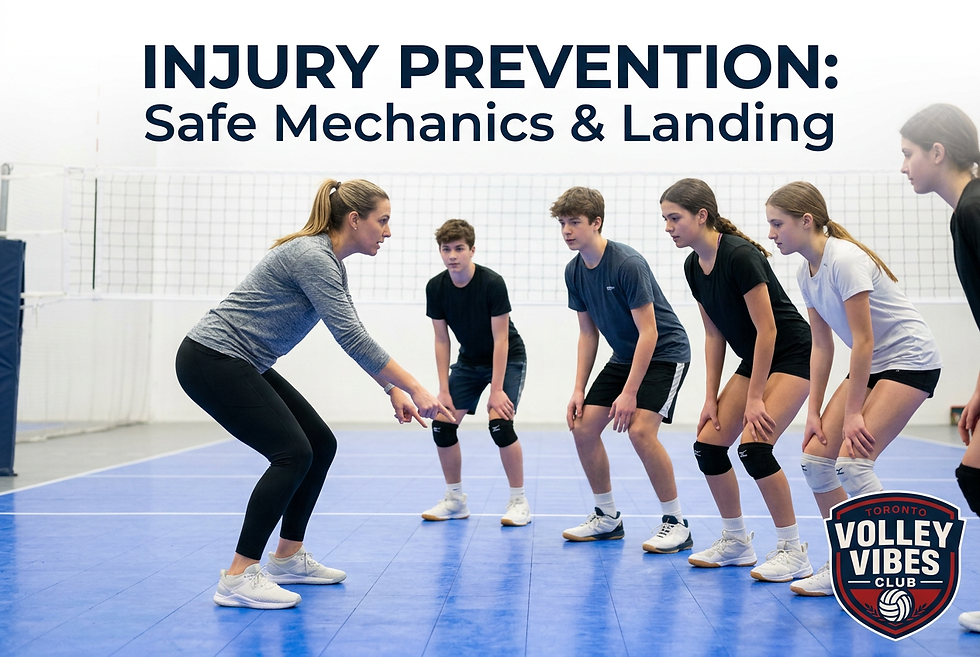
Athletes must learn to land on two feet whenever possible, with knees slightly bent to absorb the shock. Landing straight-legged or consistently on one leg leads directly to knee and hip pain.
Dynamic Warm-Ups vs. Static Stretching
A proper warm-up increases blood flow and prepares muscles for explosive movements.
Before Practice (Dynamic): High knees, lunges, arm circles, and shuffle steps. The goal is to break a light sweat and mobilize the joints.
After Practice (Static): Long holds touching toes, calf stretches, and shoulder crosses. This aids recovery and flexibility.
Parent Checklist: Injury Prevention Matrix
Risk Factor | Prevention Strategy | Why It Matters |
Footwear | Buy volleyball-specific court shoes | Provides lateral stability and jump cushioning to prevent ankle sprains. |
Hydration | Drink water before, during, and after | Dehydrated muscles cramp and tear much easier. |
Over-scheduling | Enforce rest days (no sports) | Kids playing school + rep + private lessons risk severe burnout and overuse injuries. |
Core Strength | Simple home planks and sit-ups | A strong core stabilizes the spine during aggressive serving and spiking. |
Knee Protection | Wear proper volleyball knee pads | Prevents bruising and floor burns during defensive diving. |
The "10% Rule" for Increasing Training
If your teen is moving from a beginner house league to a competitive rep team, do not suddenly double their playing time. Follow the 10% rule: increase their training volume (hours played per week) by no more than 10% each week to let their tendons and ligaments adapt safely.
Want to ensure your child is learning safe volleyball habits?Join the developmental programs at Volley Vibes Club in Markham, where proper biomechanics are built into every drill.
Call us today to book an assessment: +1 416 543 5661

Comments